How much does a business website cost in the US?
January 31, 2026
How much does a business website cost in the US?

If you run a business in the US and are thinking about building a website, one of the first questions you will ask is how much it actually costs. You will quickly notice that pricing varies a lot. Some people will say a website can be built for a few hundred dollars, while others talk about budgets in the several-thousand range, sometimes reaching $10,000 to $20,000 depending on the scope and needs of the business.

All of these numbers can be accurate, just for very different goals. The cost of a website is not only about how it looks. It depends on the number of pages, the complexity of the structure, and the role the website plays in your business.

How much does a website cost for a small or medium-sized business?

For most small and medium-sized businesses in the US, a professional website typically costs between $3,000 and $15,000.

At this level, the site usually includes around 5 to 10 pages, such as Home, About, Services, individual service pages, and Contact. These websites focus on clearly explaining what the business does, building trust, and generating inquiries or leads.

The design is tailored to the business without unnecessary complexity. The build focuses on stability, performance, and ease of maintenance. This is the most common setup for local businesses, service providers, and consultants.

How does the number of pages affect the price?

The number of pages has a major impact on cost, but not in a simple linear way. Every additional page requires more planning, layout decisions, and implementation, even when pages look similar.

A website with 3 to 5 basic pages is much simpler to build than a site with 15 or 20 different templates. As the number of service pages, CMS templates, or custom layouts increases, the overall scope and budget increase as well.

This is why it is important to think about structure and complexity, not just page count.

How much does a landing page cost?

Landing pages are often underestimated because they are only one page, but they usually have a very specific goal, which is conversion.

In the US, a professional landing page typically costs between $1,000 and $6,000 for design, and a similar amount for development. A strong landing page requires careful planning of structure, messaging, and user flow.

A good landing page directly supports marketing campaigns, sales efforts, or lead generation and can have a noticeable impact on results.

How much does a website cost for startups?

For startups, a website often plays a bigger role than simple online presence. It is used to communicate the product, support investor pitches, and create a strong first impression for users.

Budgets in this space usually look like this.
Pre-seed and seed startups often spend between $10,000 and $30,000.
Series A and later stages often range from $25,000 to $60,000 or more.

Costs are higher because the website supports long-term growth and more complex business goals.

How much do enterprise and high-growth websites cost?

For enterprise companies and fast-growing businesses, the website is often part of a larger digital ecosystem. These projects may include many pages, multiple languages, and complex content structures.

Budgets in this category often start around $30,000 to $80,000 and can go much higher depending on scope, content volume, and internal requirements.

At this level, you are paying for coordination, planning, and scalability, not just the website itself.

DIY and AI website builders

DIY website builders allow people to create websites without technical knowledge. Platforms like Wix and Squarespace offer monthly plans that include hosting, templates, and basic support.

AI-powered website builders are also becoming more common. These tools generate layouts and site structures from short descriptions and usually start around $20 per month. They can be a good option for basic websites or quick launches.

For more serious business needs, these tools often become limiting as requirements grow.

Website platforms like Webflow

Webflow sits between DIY builders and fully custom development, but it is far more powerful than most people initially expect. It offers a high level of control over design, structure, and content, while still providing managed hosting, a built-in CMS, and strong performance out of the box.

Because of this, Webflow is commonly used for small and medium-sized business websites, conversion-focused landing pages, and startup marketing sites. At the same time, it is also increasingly used for large, complex websites, including enterprise-level projects with extensive CMS structures, many pages, multiple stakeholders, and long-term scalability requirements.

With the right setup, Webflow can support large content sites, multi-page marketing platforms, and enterprise websites with dozens or even hundreds of pages. Project cost depends on scope, content complexity, and whether a template or a fully custom system is used, but Webflow projects often scale well from mid-range builds all the way to enterprise implementations, without the overhead of traditional custom platforms.

Freelancer or agency, which is the better choice?

A freelancer is often the best option for small and medium-sized businesses that need a high-quality website without a complex process. This is common for projects with a clear scope and a relatively small number of pages.

An agency makes more sense when the website is part of a broader strategy, involves many stakeholders, or includes a large volume of content, often dozens or even 100 or more pages.

How much should you realistically invest in a website?

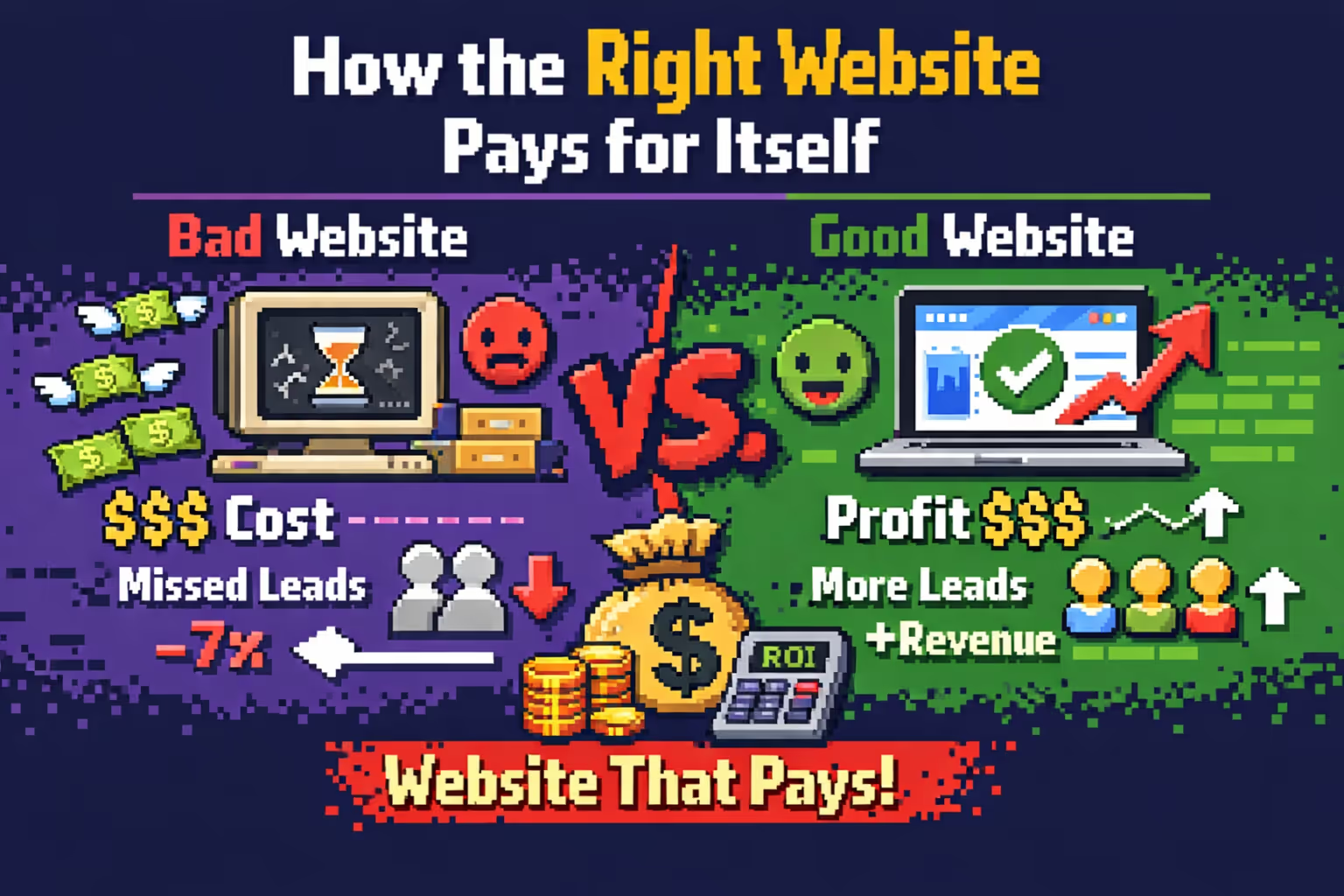
The real question is not how much a website costs, but how much it is worth to your business.

If a website brings in a few new clients each month, the investment often pays for itself quickly. On the other hand, a cheap website that does not produce results usually becomes an expense rather than an investment.

Thinking about a new website?

I am a freelance web developer working with small and medium-sized businesses. If you would like to see my pricing or talk about your project, you can check the pricing link here or reach out to me directly by email.

Frequently Asked Questions

Besides the initial build, what are the ongoing costs of a business website?

A website requires three main ongoing investments: Hosting (which for Webflow ranges from $14–$35/mo for most businesses), Domain Registration (roughly $10–$20/year), and Maintenance. Maintenance is optional but highly recommended; it covers small updates, security checks, and performance audits to ensure the site continues to run as fast as it did on launch day.

Why should I pay thousands for a custom build when I can use a $20/month DIY builder?

DIY builders are excellent for hobbies or very early-stage experiments. However, for an established business, the "cost" of a DIY site is often hidden in lost revenue. Custom builds offer superior SEO, faster load times (crucial for mobile users), and a unique design that builds trust. A professional site is built to convert visitors into customers, whereas a DIY site is often just a static digital flyer.
How long does it typically take to build a $5,000–$10,000 website?

For a professional, mid-range business website, the process usually takes between 4 to 8 weeks. This timeline includes the initial discovery and strategy phase, design, development in Webflow, content integration, and rigorous testing. Projects that require complex CMS structures or high volumes of custom copy may lean toward the 8-to-10-week mark to ensure every detail is perfect.

What is the difference in cost between a template-based site and a fully custom design?

Template-based sites are more affordable (typically $2,000–$4,000) because the structure is already defined. They are great for a quick launch. A fully custom design (starting at $5,000+) is built from the ground up to match your specific brand and user journey. Custom sites generally perform better in the long run because they aren't weighed down by the "bloat" often found in multi-purpose templates.

How do I know if my website investment is actually working?

We measure success through Conversion Tracking. During the build, we set up "Events" in Google Analytics to track exactly how many people click your "Call" button, fill out a contact form, or download a resource. By comparing the cost of the website against the "Lifetime Value" of the new leads it generates, most businesses find that a well-built site pays for itself within the first few months of operation.

Let’s talk about your project

Other articles

The Ultimate Webflow Migration Checklist for B2B & SaaS: A Stress-Free Guide to Scaling Without Losing SEO Juice

The Ultimate Webflow Migration Checklist for B2B & SaaS: A Stress-Free Guide to Scaling Without Losing SEO Juice

Moving your SaaS site to Webflow? Use this technical checklist to protect your SEO, automate CMS migration, and sync your CRM. Migrate without the stress.

The Ultimate Guide to Webflow SEO in 2026

The Ultimate Guide to Webflow SEO in 2026

Master Webflow SEO in 2026. Learn how to leverage AI, optimize for zero-click searches, and boost site speed with Webflow’s built-in tools. Start ranking higher!

From Figma to Webflow: The Definitive Guide for 2026

From Figma to Webflow: The Definitive Guide for 2026

Turn Figma designs into high-performance Webflow websites with a structured workflow, clean architecture, and modern best practices.

Webflow vs Lovable: a platform comparison. Which one is better?

Webflow vs Lovable: a platform comparison. Which one is better?

A practical comparison of Webflow and Lovable. Learn which no-code platform is better for design flexibility, SEO, scalability, and long-term website growth.

Best No-Code Platforms for Websites in 2026: A Complete Comparison

Best No-Code Platforms for Websites in 2026: A Complete Comparison

A complete comparison of the best no-code platforms for building websites in 2026. Compare Webflow, Framer, Wordpress, and more to choose the right platform for your project.

Webflow and Framer: A Practical Comparison for 2026

Webflow and Framer: A Practical Comparison for 2026

Full 2026 Webflow vs Framer comparison covering CMS power, pricing, SEO tools, AI features, and which no-code platform fits your project.

Webflow App Gen: A Complete Guide to the AI Revolution in Web App Generation

Webflow App Gen: A Complete Guide to the AI Revolution in Web App Generation

Learn what Webflow App Gen is and how it uses AI to generate production-ready web applications directly inside Webflow. Features, CMS integration, and deployment explained.

Webflow Migration Guide: How to Move Your B2B Website Without Losing SEO Rankings

Webflow Migration Guide: How to Move Your B2B Website Without Losing SEO Rankings

Learn how to migrate your B2B website to Webflow without losing SEO rankings. A practical guide covering redirects, CMS structure, performance, and post-launch checks.

SEO, AEO, and GEO: what should you focus on in 2026?

SEO, AEO, and GEO: what should you focus on in 2026?

Learn the difference between SEO, AEO, and GEO, how search is evolving, and what to focus on in 2026 to stay visible in AI-driven and traditional search.

The difference between award-winning and high-converting websites

The difference between award-winning and high-converting websites

What’s the real difference between award-winning and high-converting websites? Learn how design goals, usability, and strategy impact business results.

How to fix conversion issues when you already have traffic

How to fix conversion issues when you already have traffic

Your website gets traffic but no leads? Learn why visitors aren’t converting and how better design, messaging, and structure can turn traffic into real business results.

Migrating to Webflow from other platforms

Migrating to Webflow from other platforms

Learn how migrating to Webflow from WordPress or other platforms works, what the real process looks like, and how it affects performance, scalability, and SEO.

Why SaaS companies should move to Webflow in 2026

Why SaaS companies should move to Webflow in 2026

Discover why SaaS companies are moving to Webflow in 2026 for better performance, SEO control, scalability, and faster marketing workflows.

Is Webflow Good for SEO? What Actually Matters

Is Webflow Good for SEO? What Actually Matters

Is Webflow good for SEO? Learn what actually affects rankings, from content and structure to technical setup, and why Webflow isn’t the problem.

Webflow vs WordPress which platform is right for your website

Webflow vs WordPress which platform is right for your website

This article breaks down whether Webflow is a better alternative to WordPress.

Should designers understand Webflow frameworks for smoother projects?

Should designers understand Webflow frameworks for smoother projects?

Learn why designers benefit from understanding Webflow frameworks and how shared structure improves collaboration, reduces friction, and keeps projects running smoothly.

Why the right Webflow framework matters for scalable websites?

Why the right Webflow framework matters for scalable websites?

Learn why the right Webflow framework is key to building scalable, consistent, and easy to maintain websites.

A closer look at Webflow components

A closer look at Webflow components

Learn why Webflow components are essential for scalable websites and how a component based approach improves consistency, speed, and long term growth.

When design breaks the development process and slows growth

When design breaks the development process and slows growth

Learn how poor design decisions create friction in development, introduce technical debt, and limit long term website scalability and growth.

Why marketing teams struggle to maintain Webflow projects on their own?

Why marketing teams struggle to maintain Webflow projects on their own?

Learn why marketing teams often struggle to manage Webflow websites, the structural mistakes behind it, and how to build a site that supports growth.

Why most Webflow websites do not scale well?

Why most Webflow websites do not scale well?

Learn why many Webflow websites struggle to scale, the structural mistakes behind them, and how to build a Webflow site that supports long term growth.

Webflow vs Custom code: How to choose the right approach for your website?

Webflow vs Custom code: How to choose the right approach for your website?

A clear comparison of Webflow and custom code, focused on choosing the right solution based on speed, flexibility, and business maturity.