Why the right Webflow framework matters for scalable websites?
December 18, 2025
Why the right Webflow framework matters for scalable websites?

When talking about Webflow development, a framework often sounds like a minor technical detail that doesn’t really matter. In practice, it’s exactly the opposite. A framework directly affects development speed, design consistency, website maintenance, and the long-term growth of a project. It’s not just about how classes are named, but about how the entire website is structured and approached.

Without a clear framework, Webflow projects quickly become messy. Classes get duplicated, spacing becomes inconsistent, and every new page requires extra thinking and improvisation. With a solid framework in place, a project gains a system, not just a visual design.

What a framework means in Webflow

A Webflow framework is a set of rules, conventions, and structural decisions that define how a website is built. This includes class naming conventions, element organization, spacing systems, working with components and CMS collections, and collaboration between designers and developers.

In other words, a framework helps everyone follow the same rules and ensures the website remains readable, maintainable, and scalable months or even years later.

Why frameworks are so important

The first reason is consistency. When a framework is used, all elements on the website follow the same system. Margins, padding, typography, and layouts behave predictably. This eliminates visual inconsistencies and ensures the website looks professional across every page.

The second reason is speed. Once the system is set up, building new pages and sections becomes much faster. There’s no need to reinvent solutions every time, existing classes and components can simply be reused.

The third reason is maintenance. When a client or another developer takes over the project, the structure is immediately understandable. Changes can be made quickly and safely, without breaking unrelated parts of the website.
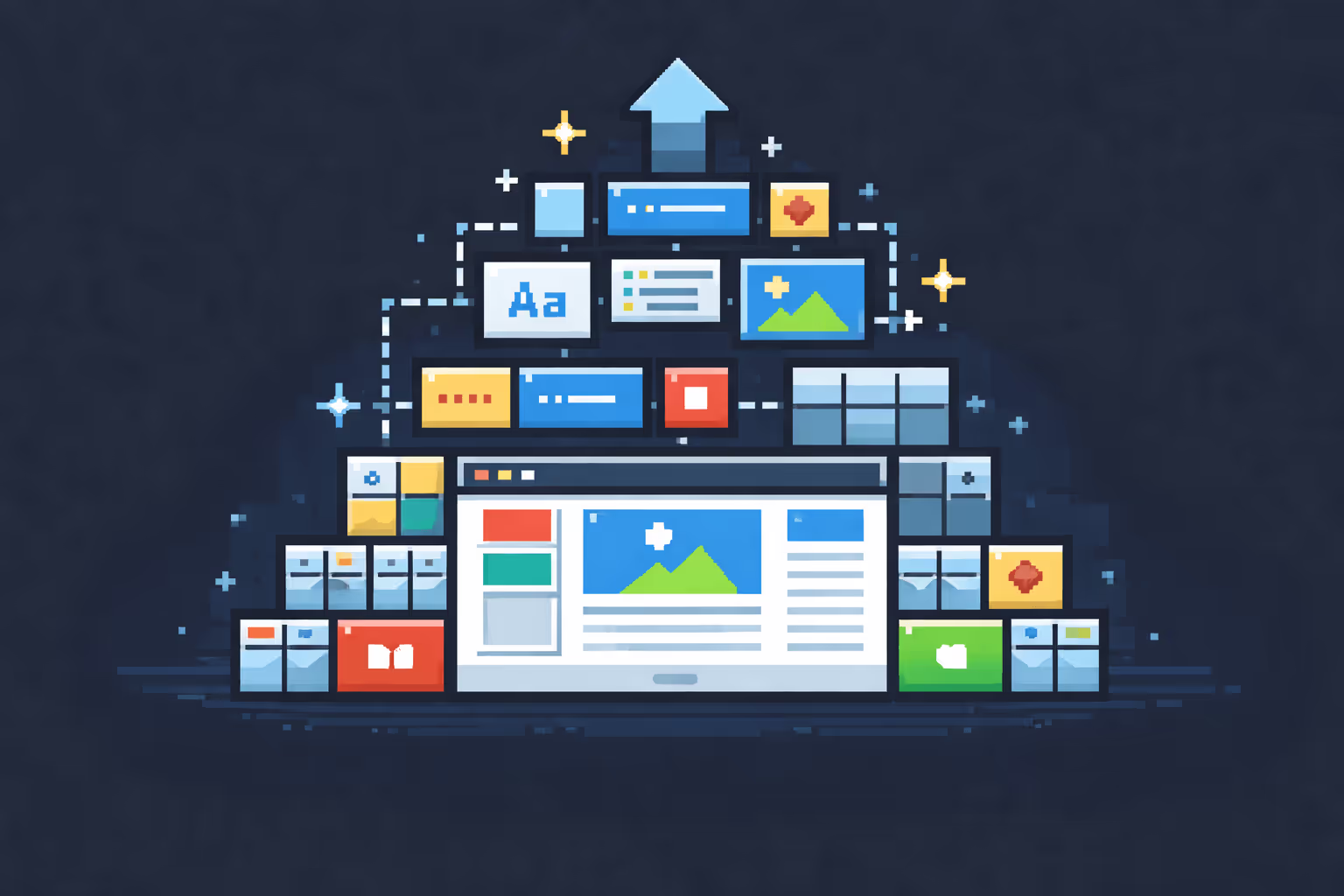
Finally, frameworks are essential for scalability. A website that starts with five pages can easily grow to fifty. Without a system in place, that kind of growth quickly turns into a problem.

The role of a Style Guide in Webflow projects

A framework defines structure and logic, but a Style Guide brings visual consistency to a Webflow project. Together, they form the foundation of a scalable and maintainable website.

A Style Guide centralizes key design decisions such as typography, colors, spacing, buttons, form elements, and global components. Instead of styling elements individually across the site, everything is defined once and reused consistently.

This becomes especially important as a website grows. Without a Style Guide, visual inconsistencies quickly appear. Headings slightly change in size, colors drift over time, and spacing becomes unpredictable. With a proper Style Guide in place, design decisions remain intentional and controlled.
From a development perspective, a Style Guide dramatically improves speed and maintainability. New pages can be built faster by reusing existing styles, and global updates become simple and safe. Changing a primary color, adjusting typography, or updating a button style can be done in one place without breaking the rest of the site.

Most importantly, a Style Guide allows teams to collaborate more effectively. Designers, developers, and marketing teams all work from the same visual system. This reduces friction, prevents guesswork, and ensures the website stays consistent long after the initial launch.

Most well-known Webflow frameworks

Within the Webflow ecosystem, several frameworks are commonly used today, each with its own strengths and focus.

Client First

Client First is by far the most well-known Webflow framework. It focuses on clear class naming, simple structure, and smooth collaboration between designers, developers, and marketing teams. Because of its popularity, a large number of Webflow projects on the market are built using Client First.

Saddle

The Saddle framework is oriented toward fast-moving marketing websites and landing pages. It offers a clear system and a good balance between flexibility and structure, although it is less widely used than Client First.

Lumos

Lumos is a more modern framework with a strong emphasis on components and scalable design systems. It’s often used on more complex projects where a component-based approach is a top priority.

MAST

The MAST framework is structured, modular, and particularly well-suited for larger projects and long-term maintenance. Its strength lies in clearly defined layers, consistency, and the ability to build websites as complete systems rather than collections of individual pages.

Which framework should you use and why

There is no universal framework that works best for every project. The right choice depends on the type of website, the team involved, and the overall goals of the project. However, experience shows that working without any framework almost always leads to problems later on.

My first framework was Client First. The reason is simple. It’s the most in-demand framework on the market, and the majority of Webflow projects today are built using it. Working with Client First gave me a strong foundation, a solid understanding of Webflow structure, and the ability to easily integrate into existing projects and teams.

Today, when starting new projects, I mostly use the MAST framework. The reasons are straightforward. MAST gives me more control over structure, works exceptionally well with a component-based approach, and allows websites to grow without losing order. It has proven to be a strong choice for long-term projects, complex CMS setups, and websites with multiple page types.

Its biggest advantages are clear organization, consistency across the entire project, and easier maintenance as the project scales.

Conclusion

Choosing the right framework in Webflow is not a small technical detail. It’s a strategic decision. A good framework saves time, reduces errors, and allows a website to grow alongside the business behind it. Whether you use Client First, Saddle, Lumos, or MAST, the most important thing is that a framework exists and is applied consistently.

A framework turns a Webflow website from a simple design into a stable and reliable system. This is a difference you may not notice immediately, but one that becomes very clear over time.

Let’s talk about your project

Other articles

Why SaaS companies should move to Webflow in 2026

Why SaaS companies should move to Webflow in 2026

Discover why SaaS companies are moving to Webflow in 2026 for better performance, SEO control, scalability, and faster marketing workflows.

Is Webflow Good for SEO? What Actually Matters

Is Webflow Good for SEO? What Actually Matters

Is Webflow good for SEO? Learn what actually affects rankings, from content and structure to technical setup, and why Webflow isn’t the problem.

Webflow vs WordPress which platform is right for your website

Webflow vs WordPress which platform is right for your website

This article breaks down whether Webflow is a better alternative to WordPress.

Should designers understand Webflow frameworks for smoother projects?

Should designers understand Webflow frameworks for smoother projects?

Learn why designers benefit from understanding Webflow frameworks and how shared structure improves collaboration, reduces friction, and keeps projects running smoothly.

A closer look at Webflow components

A closer look at Webflow components

Learn why Webflow components are essential for scalable websites and how a component based approach improves consistency, speed, and long term growth.

When design breaks the development process and slows growth

When design breaks the development process and slows growth

Learn how poor design decisions create friction in development, introduce technical debt, and limit long term website scalability and growth.

Why marketing teams struggle to maintain Webflow projects on their own?

Why marketing teams struggle to maintain Webflow projects on their own?

Learn why marketing teams often struggle to manage Webflow websites, the structural mistakes behind it, and how to build a site that supports growth.

Why most Webflow websites do not scale well?

Why most Webflow websites do not scale well?

Learn why many Webflow websites struggle to scale, the structural mistakes behind them, and how to build a Webflow site that supports long term growth.

Webflow vs Custom code: How to choose the right approach for your website?

Webflow vs Custom code: How to choose the right approach for your website?

A clear comparison of Webflow and custom code, focused on choosing the right solution based on speed, flexibility, and business maturity.