The Ultimate Guide to Webflow SEO in 2026
February 3, 2026
The Ultimate Guide to Webflow SEO in 2026

SEO in 2026 has evolved far beyond simple keyword stuffing. Today, search dominance is defined by User Experience (UX), AI integration, and technical adaptability. To stay ahead, you must pivot toward refreshing legacy content, maximizing site speed, and capturing zero-click searches. Webflow makes this transition seamless with its built-in SEO suite, high-performance hosting, and flexible CMS.
Why SEO in 2026 Requires a Fresh Approach

With the rise of AI-driven search experiences and strict "mobile-first" indexing, generic strategies no longer cut it. Users demand instant, relevant answers. Success in 2026 requires a synergy between human-centered design and technical precision. This guide explores how to leverage Webflow’s unique architecture to outperform the competition.
1. The Power of Refreshing Legacy Content

Updating old blog posts is one of the most effective, yet underrated, SEO tactics. Search engines prioritize accuracy and relevance; an article from three years ago won't rank if the data is obsolete.

  • Audit Your Assets: Identify pages with declining traffic.
  • Inject Fresh Insights: Add new statistics, updated visuals, and current trends.
  • Optimize Meta Data: Rewrite titles and descriptions to include long-tail keywords.
  • Webflow Tip: Use the Webflow CMS to easily filter and manage content updates, ensuring your archive remains a competitive asset.

2. Speed as a Ranking Factor: The Webflow Edge

Site speed is no longer just a "nice-to-have"—it is a critical ranking factor. A one-second delay can decimate your conversion rate. Webflow provides a massive advantage here because your site is hosted on the Fastly Network and backed by Amazon Web Services (AWS).

  • Image Compression: Use WebP formats to maintain quality at a fraction of the size.
  • Native Lazy Loading: Webflow automatically sets images to lazy load, meaning they only render when needed.
  • Clean Code: Unlike other builders, Webflow produces semantic, bloat-free code that search engine crawlers can index effortlessly.

3. Integrating AI with Webflow CMS

AI is reshaping the SEO workflow. By combining AI’s analytical power with Webflow’s flexible CMS, you can identify content gaps and automate keyword research.

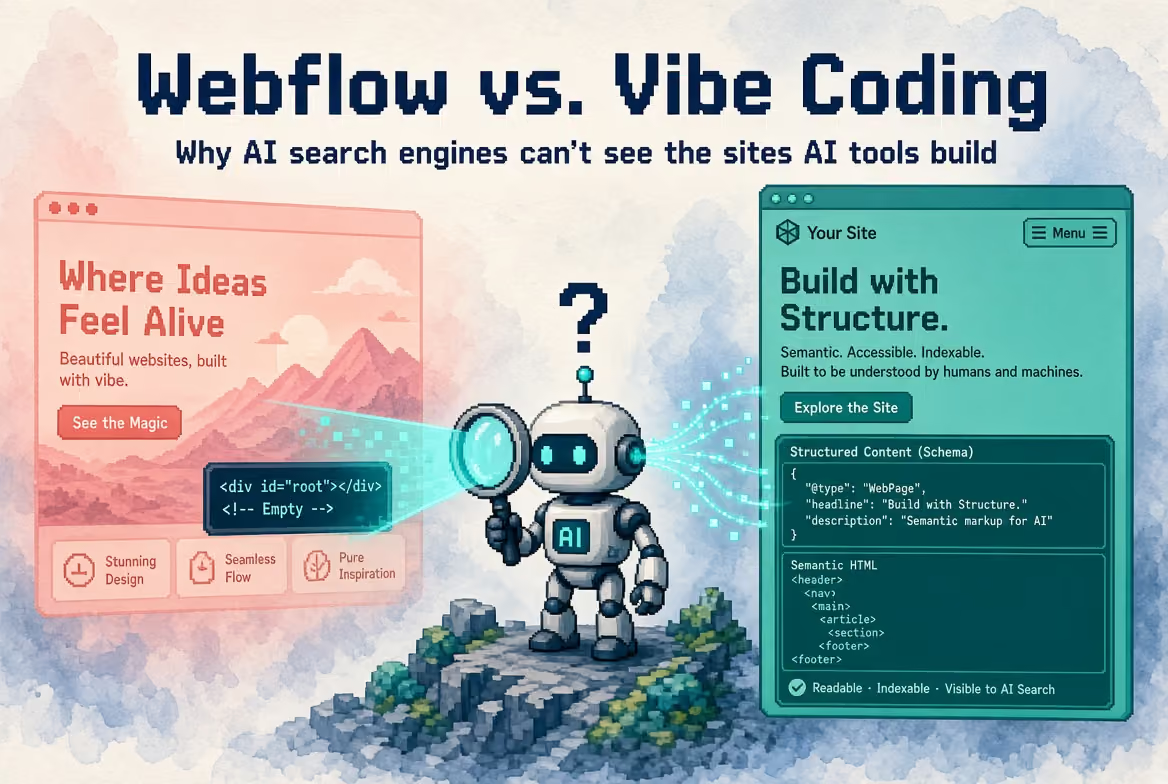
  • Structured Data: Webflow allows you to create custom Schema Markup, helping AI-powered search engines understand your content's context (e.g., reviews, events, or products).
  • Trend Analysis: Use AI tools to track user behavior and adjust your CMS collections to match emerging search patterns.

4. Dominating "Zero-Click" Searches

A "Zero-Click" search is when a user finds their answer directly on the Google results page (via Featured Snippets) without clicking a link. To win these:

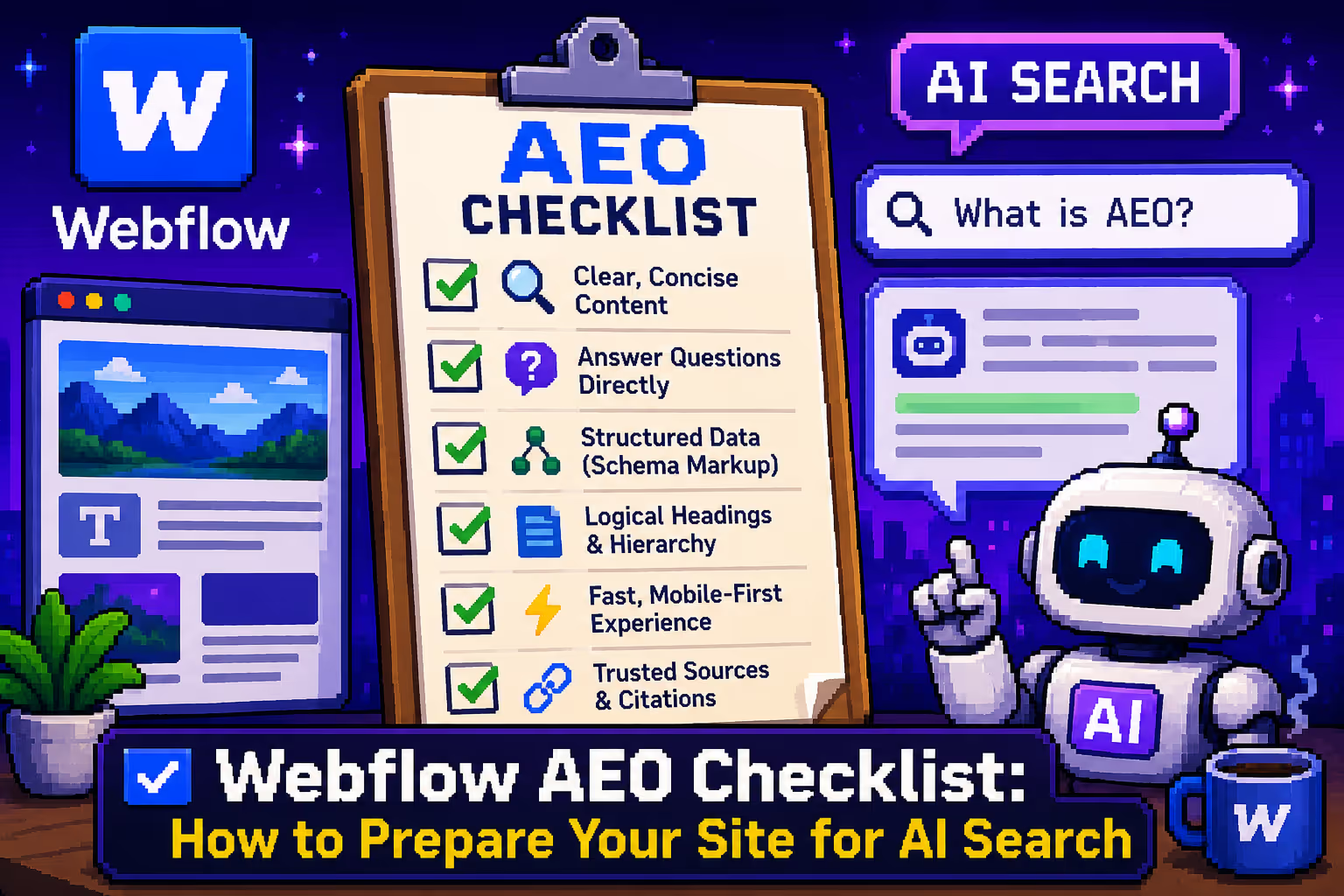
  • Answer Directly: Use clear, concise language in your H2 and H3 subheadings.
  • Structured Content: Utilize bulleted lists and tables.
  • FAQ Sections: Add an FAQ schema to your pages to capture more real estate on the SERP.
  • Webflow Tip: Use Webflow’s heading hierarchy tools to ensure your H1-H6 tags are perfectly structured for Google’s snippets.

5. Elevating UX with Video SEO

Video content is essential for 2026. It increases "dwell time" (how long users stay on your site), which signals to Google that your content is valuable.

  • Accessibility: Always include transcripts and optimized alt-text for videos.
  • Engagement: Host videos via Webflow’s native hosting or embed from high-speed platforms like YouTube or Vidzflow to ensure they don't slow down your page.

6. Technical Excellence: The Webflow SEO Checklist

Webflow is more than a CMS; it is a professional development toolbox. To ensure your site is technically perfect, follow this checklist:

  1. Hreflang Tags: Essential for international SEO and geo-targeting.
  2. Canonical Tags: Prevent duplicate content issues with a single click in page settings.
  3. 301 Redirects: Manage URL changes within the Webflow dashboard to maintain link equity.
  4. SSL Certification: Webflow provides SSL by default, ensuring your site is secure and trusted by search engines.

7. The Webflow Audit Tool: Your Pre-Flight Check

Before you hit "Publish," use the built-in Webflow Audit Tool. It scans your site for:

  • Missing Alt-text on images.
  • Non-descriptive link text.
  • Broken heading hierarchies.By resolving these issues instantly, you avoid search engine penalties and ensure a superior experience for all users.

Conclusion

SEO in 2026 is the perfect marriage of creativity and technology. By focusing on site speed, AI-driven insights, and user-centric content, you can secure a top spot in the search rankings. Webflow provides the foundation; your strategy provides the growth.

Now is the time to act—audit your top-performing page today and see how these 2026 practices can amplify your results!

Frequently Asked Questions

How does Webflow help my site rank in AI-driven search engines like Google SGE or Perplexity?

AI search engines rely heavily on structured data to understand the context of your content. Webflow’s ability to implement custom Schema Markup across CMS collections allows you to "feed" these AI crawlers precise data about your products, reviews, or articles. By providing clear, structured context, you increase the chances of your site being cited as a primary source in AI-generated answers.

What is the fastest way to optimize Webflow for "Zero-Click" searches?

The key is the "Answer-First" formatting. In your Webflow CMS, ensure your H2 or H3 subheadings are phrased as direct questions, followed immediately by a concise 40-50 word answer. Using Webflow’s list elements or tables also makes it significantly easier for Google to pull your data into a Featured Snippet, allowing users to find the answer without ever leaving the search results page.

Should I delete old blog posts or just refresh them?

Unless the content is completely irrelevant to your current brand, refreshing is almost always better than deleting. Deleting a post destroys any existing "backlink equity" that page has built over the years. By using the Webflow CMS to update the publication date, refreshing the statistics, and improving the UX with better visuals, you signal to Google that the page is once again a high-value resource.

Does Webflow’s hosting really provide an SEO advantage over other platforms?

Yes, primarily through technical reliability and speed. Webflow sites are hosted on a Tier 1 Global CDN (Fastly and AWS), which ensures your site loads rapidly regardless of the user's location. Since site speed and "Time to First Byte" (TTFB) are core ranking factors in 2026, the out-of-the-box infrastructure of Webflow gives you a head start over platforms that require manual server configuration or heavy plugin stacks.

Will adding video content for SEO significantly slow down my Webflow site?

It won't if handled correctly. In 2026, the strategy is to use "Lazy Loading" for video containers and to host large files on high-speed external platforms while embedding them into Webflow. This allows you to reap the SEO benefits of increased "dwell time" without the heavy file size affecting your initial Lighthouse performance score. Always prioritize mobile-optimized formats to ensure the video doesn't block the main rendering path.

Let’s talk about your project

Other articles

The Ultimate Webflow Migration Checklist for B2B & SaaS: A Stress-Free Guide to Scaling Without Losing SEO Juice

The Ultimate Webflow Migration Checklist for B2B & SaaS: A Stress-Free Guide to Scaling Without Losing SEO Juice

Moving your SaaS site to Webflow? Use this technical checklist to protect your SEO, automate CMS migration, and sync your CRM. Migrate without the stress.

From Figma to Webflow: The Definitive Guide for 2026

From Figma to Webflow: The Definitive Guide for 2026

Turn Figma designs into high-performance Webflow websites with a structured workflow, clean architecture, and modern best practices.

How much does a business website cost in the US?

How much does a business website cost in the US?

Learn how much a business website really costs in the US. A clear breakdown of pricing for small businesses, startups, landing pages, and larger projects.

Webflow vs Lovable: a platform comparison. Which one is better?

Webflow vs Lovable: a platform comparison. Which one is better?

A practical comparison of Webflow and Lovable. Learn which no-code platform is better for design flexibility, SEO, scalability, and long-term website growth.

Best No-Code Platforms for Websites in 2026: A Complete Comparison

Best No-Code Platforms for Websites in 2026: A Complete Comparison

A complete comparison of the best no-code platforms for building websites in 2026. Compare Webflow, Framer, Wordpress, and more to choose the right platform for your project.

Webflow and Framer: A Practical Comparison for 2026

Webflow and Framer: A Practical Comparison for 2026

Full 2026 Webflow vs Framer comparison covering CMS power, pricing, SEO tools, AI features, and which no-code platform fits your project.

Webflow App Gen: A Complete Guide to the AI Revolution in Web App Generation

Webflow App Gen: A Complete Guide to the AI Revolution in Web App Generation

Learn what Webflow App Gen is and how it uses AI to generate production-ready web applications directly inside Webflow. Features, CMS integration, and deployment explained.

Webflow Migration Guide: How to Move Your B2B Website Without Losing SEO Rankings

Webflow Migration Guide: How to Move Your B2B Website Without Losing SEO Rankings

Learn how to migrate your B2B website to Webflow without losing SEO rankings. A practical guide covering redirects, CMS structure, performance, and post-launch checks.

SEO, AEO, and GEO: what should you focus on in 2026?

SEO, AEO, and GEO: what should you focus on in 2026?

Learn the difference between SEO, AEO, and GEO, how search is evolving, and what to focus on in 2026 to stay visible in AI-driven and traditional search.

The difference between award-winning and high-converting websites

The difference between award-winning and high-converting websites

What’s the real difference between award-winning and high-converting websites? Learn how design goals, usability, and strategy impact business results.

How to fix conversion issues when you already have traffic

How to fix conversion issues when you already have traffic

Your website gets traffic but no leads? Learn why visitors aren’t converting and how better design, messaging, and structure can turn traffic into real business results.

Migrating to Webflow from other platforms

Migrating to Webflow from other platforms

Learn how migrating to Webflow from WordPress or other platforms works, what the real process looks like, and how it affects performance, scalability, and SEO.

Why SaaS companies should move to Webflow in 2026

Why SaaS companies should move to Webflow in 2026

Discover why SaaS companies are moving to Webflow in 2026 for better performance, SEO control, scalability, and faster marketing workflows.

Is Webflow Good for SEO? What Actually Matters

Is Webflow Good for SEO? What Actually Matters

Is Webflow good for SEO? Learn what actually affects rankings, from content and structure to technical setup, and why Webflow isn’t the problem.

Webflow vs WordPress which platform is right for your website

Webflow vs WordPress which platform is right for your website

This article breaks down whether Webflow is a better alternative to WordPress.

Should designers understand Webflow frameworks for smoother projects?

Should designers understand Webflow frameworks for smoother projects?

Learn why designers benefit from understanding Webflow frameworks and how shared structure improves collaboration, reduces friction, and keeps projects running smoothly.

Why the right Webflow framework matters for scalable websites?

Why the right Webflow framework matters for scalable websites?

Learn why the right Webflow framework is key to building scalable, consistent, and easy to maintain websites.

A closer look at Webflow components

A closer look at Webflow components

Learn why Webflow components are essential for scalable websites and how a component based approach improves consistency, speed, and long term growth.

When design breaks the development process and slows growth

When design breaks the development process and slows growth

Learn how poor design decisions create friction in development, introduce technical debt, and limit long term website scalability and growth.

Why marketing teams struggle to maintain Webflow projects on their own?

Why marketing teams struggle to maintain Webflow projects on their own?

Learn why marketing teams often struggle to manage Webflow websites, the structural mistakes behind it, and how to build a site that supports growth.

Why most Webflow websites do not scale well?

Why most Webflow websites do not scale well?

Learn why many Webflow websites struggle to scale, the structural mistakes behind them, and how to build a Webflow site that supports long term growth.

Webflow vs Custom code: How to choose the right approach for your website?

Webflow vs Custom code: How to choose the right approach for your website?

A clear comparison of Webflow and custom code, focused on choosing the right solution based on speed, flexibility, and business maturity.