Why marketing teams struggle to maintain Webflow projects on their own?
December 6, 2025
Why marketing teams struggle to maintain Webflow projects on their own?

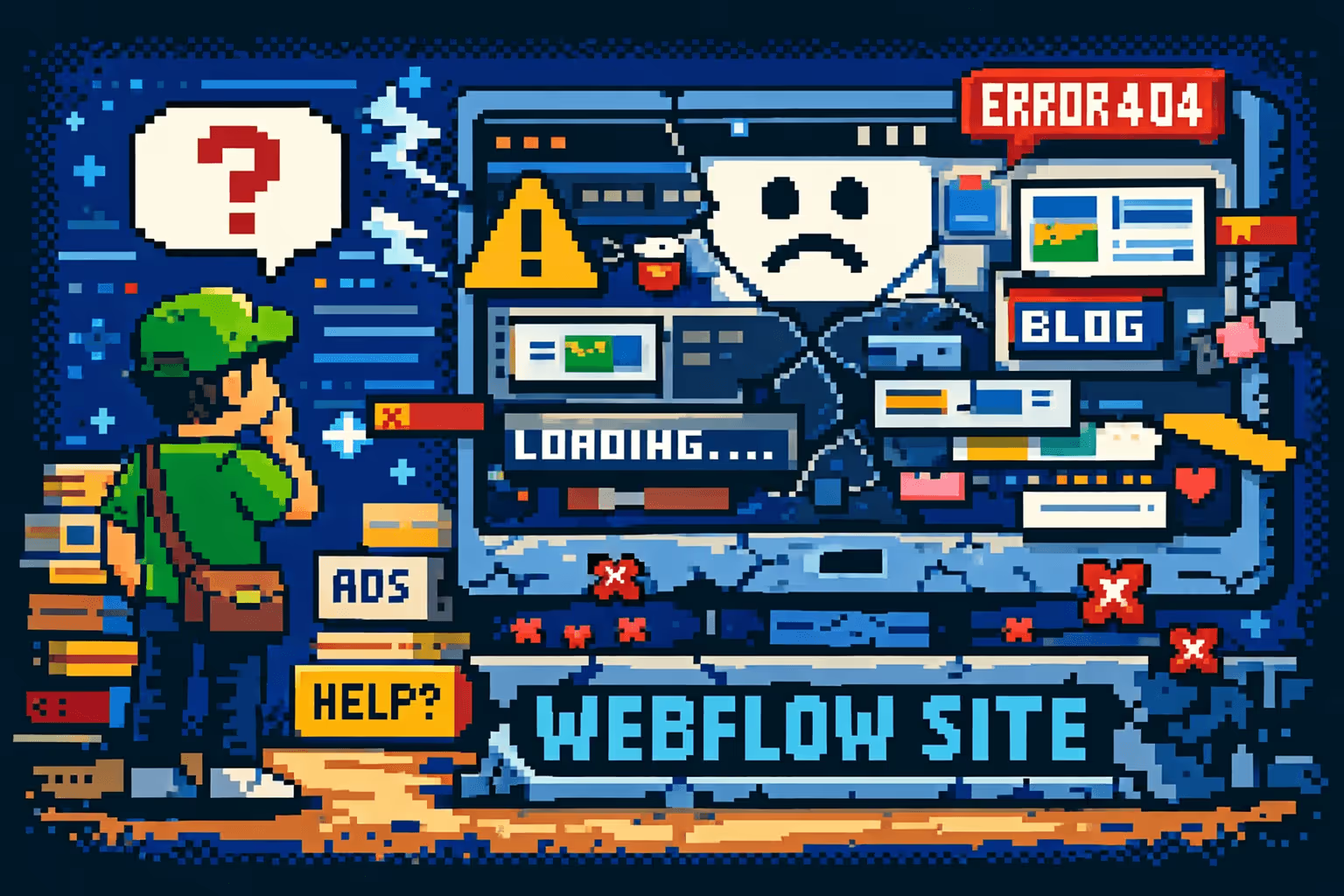
Webflow is often positioned as a platform that gives marketing teams more autonomy and control over their websites. In theory, this means less reliance on developers and faster execution of campaigns. In practice, however, many marketing teams quickly find themselves afraid to touch their own website. Instead of feeling empowered, they experience uncertainty, slower execution, and constant dependence on technical support.

This problem rarely has anything to do with the skills of the marketing team or with limitations of Webflow as a platform. The real issue lies in how the website was built and whether it was ever designed to be maintained by non technical teams in the long run.

Webflow promises autonomy but does not guarantee it

One of Webflow’s biggest strengths is visual content management. However, the platform itself does not guarantee that a website will be easy to maintain. If the structure is unclear, components are not standardized, and the CMS is not thoughtfully designed, autonomy quickly becomes an illusion.

Marketing teams may have access to the editor, but without a clear understanding of what is safe to change and what is not, every update feels risky. In this environment, teams naturally pull back and avoid touching anything that currently works.

The fear of breaking the website

One of the most common reasons marketing teams avoid maintaining Webflow websites themselves is the fear of breaking something. This fear does not come out of nowhere. When sections are tightly coupled, class structures lack logic, and changes in one place affect multiple pages, the risk becomes very real.

In these situations, even simple edits such as changing copy or replacing an image can cause unintended issues. Over time, teams develop a habit of avoiding changes altogether, which directly impacts iteration speed and the ability to respond to the market.

Lack of a clear system and reusable components

Marketing teams work best when they operate within clear patterns. When every new page requires a different approach and fresh decision making, maintenance becomes slow and frustrating. Many Webflow websites look visually polished but lack clearly defined reusable components.

Without repeatable sections and a consistent structure, every update becomes a special case. Instead of relying on a system, marketing teams are forced to reverse engineer how things were previously built and whether it is safe to replicate them.

A CMS designed for developers instead of marketers

The CMS is often the biggest source of friction. Fields are frequently named in technical terms, relationships between collections are unclear, and content entry workflows are not intuitive. Even experienced marketers can easily make mistakes in this setup.

When the CMS does not reflect how marketing teams think about content, it slows them down instead of enabling them. Every new campaign turns into a small technical project, and Webflow loses one of its core advantages.

Missing documentation and onboarding

Another common issue is the lack of basic documentation. Marketing teams are often handed a finished website without any explanation of how the system is meant to be used. Rules are undefined and best practices remain unclear.

Without proper onboarding, knowledge is passed informally or through trial and error. This increases uncertainty and reinforces dependency on developers, even when teams could technically handle updates themselves.

When a Webflow website becomes a marketing bottleneck

A website that marketing teams cannot maintain independently becomes a bottleneck instead of a growth tool. Campaigns are delayed, experimentation slows down, and opportunities are missed because every change requires additional coordination.

At this point, the problem is no longer technical. It becomes a business issue that directly impacts growth and competitiveness. Webflow often gets blamed for not scaling, even though the root cause is poor implementation.

How Webflow should actually work for marketing teams

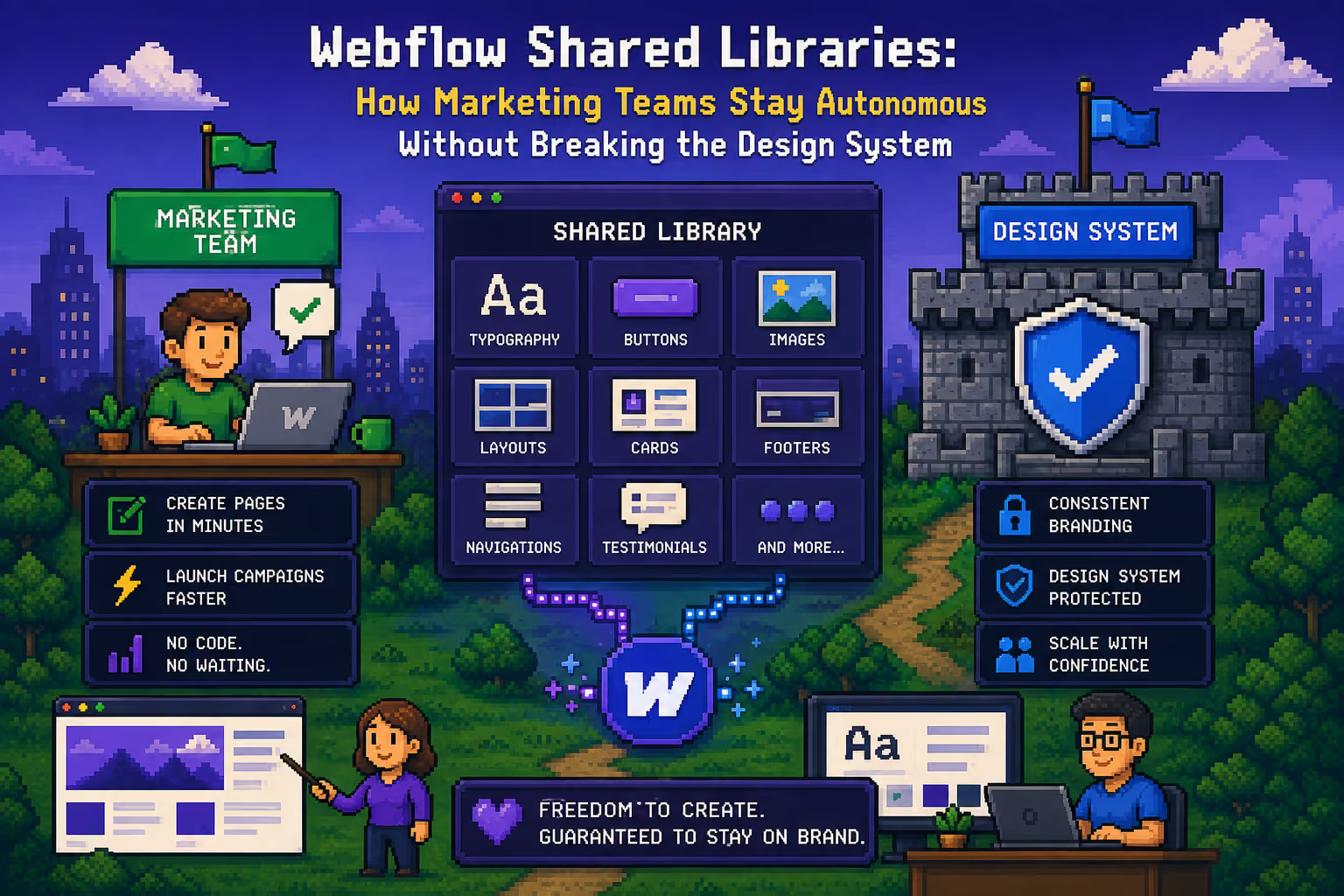
When Webflow is set up correctly, marketing teams can work independently with a high level of confidence. The structure is clear, components are reusable, and the CMS is designed around the way marketers actually work.

In this kind of system, changes are predictable, risk is minimal, and the website becomes a tool that supports speed and experimentation. Marketing teams can focus on messaging, value, and performance rather than technical details.

Where the real solution lies

If marketing teams struggle to maintain Webflow websites on their own, the solution is not switching tools or adding internal restrictions. The solution lies in how the website is built and who builds it.

The key factor is working with a developer or agency that understands a Webflow website is not just a design project, but a long term system. The site must be built in a way that allows marketing teams to work confidently, understand the structure, and make changes without constant technical assistance.

When working with agencies, extra caution is important. In many cases, agencies assign junior developers to most of the project work, while senior team members are involved only at the beginning or at a review level. This is not necessarily bad, but it can become a problem if expectations are not aligned early. Before signing a contract, it is important to understand who will actually be working on your project and what experience they have with similar systems.

Working with a freelancer often makes ownership more transparent. It is usually easier to see which projects they have worked on, how they think, and to know that the same person will be directly responsible for your website. Even then, it is still important to be cautious and ensure the freelancer is thinking beyond delivery and focusing on long term maintainability and growth.


From personal experience, I know how confusing these decisions can be. I have seen how a website can become a bottleneck instead of a tool, and how frustrating that is for both marketing teams and founders. That is why these choices deserve a thoughtful, long term approach rather than a rushed decision.

If you would like to discuss your Webflow website, its structure, or your growth plans, you can schedule a discovery call using the link. The goal of the conversation is to understand where you are today and whether Webflow can become a system that truly supports your marketing and growth instead of slowing it down.

Let’s talk about your project

Other articles

Why SaaS companies should move to Webflow in 2026

Why SaaS companies should move to Webflow in 2026

Discover why SaaS companies are moving to Webflow in 2026 for better performance, SEO control, scalability, and faster marketing workflows.

Is Webflow Good for SEO? What Actually Matters

Is Webflow Good for SEO? What Actually Matters

Is Webflow good for SEO? Learn what actually affects rankings, from content and structure to technical setup, and why Webflow isn’t the problem.

Webflow vs WordPress which platform is right for your website

Webflow vs WordPress which platform is right for your website

This article breaks down whether Webflow is a better alternative to WordPress.

Should designers understand Webflow frameworks for smoother projects?

Should designers understand Webflow frameworks for smoother projects?

Learn why designers benefit from understanding Webflow frameworks and how shared structure improves collaboration, reduces friction, and keeps projects running smoothly.

Why the right Webflow framework matters for scalable websites?

Why the right Webflow framework matters for scalable websites?

Learn why the right Webflow framework is key to building scalable, consistent, and easy to maintain websites.

A closer look at Webflow components

A closer look at Webflow components

Learn why Webflow components are essential for scalable websites and how a component based approach improves consistency, speed, and long term growth.

When design breaks the development process and slows growth

When design breaks the development process and slows growth

Learn how poor design decisions create friction in development, introduce technical debt, and limit long term website scalability and growth.

Why most Webflow websites do not scale well?

Why most Webflow websites do not scale well?

Learn why many Webflow websites struggle to scale, the structural mistakes behind them, and how to build a Webflow site that supports long term growth.

Webflow vs Custom code: How to choose the right approach for your website?

Webflow vs Custom code: How to choose the right approach for your website?

A clear comparison of Webflow and custom code, focused on choosing the right solution based on speed, flexibility, and business maturity.