Astro vs Webflow: A complete comparison for 2026
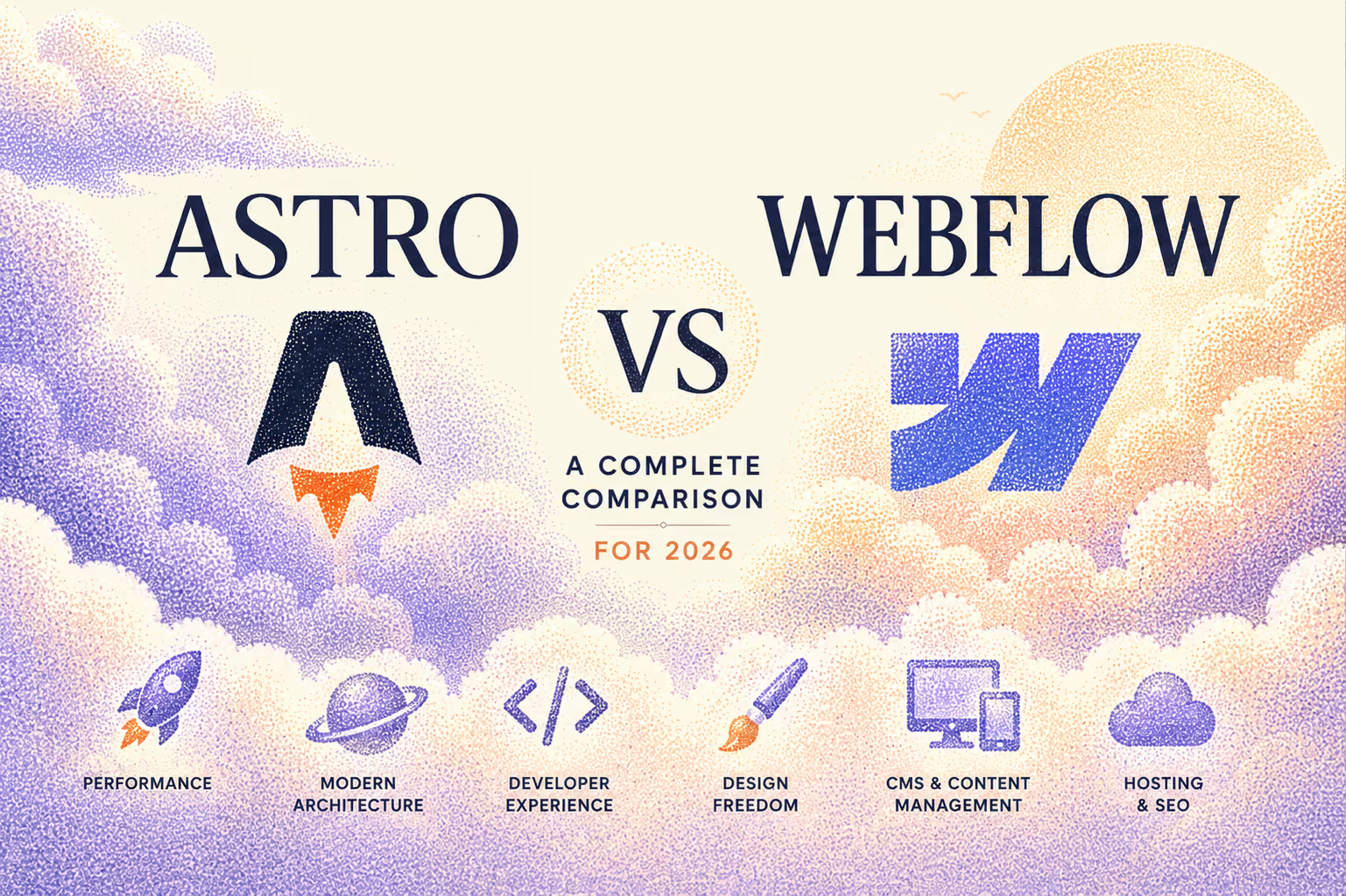
If you have been researching how to build a marketing site in 2026, you have probably come across both Astro and Webflow. On the surface they seem to solve the same problem. In practice, they make very different assumptions about who builds your site, who maintains it, and what you are willing to trade off to get there.
This post covers both platforms honestly, where each one excels, where each one falls short, and what the right questions are before you pick one.
What Astro is and why it has grown
Astro is an open-source web framework built specifically for content-driven websites. Unlike Next.js, which is a general-purpose React framework, Astro was designed from the start with one priority: ship as little JavaScript as possible.
The way it works is through what Astro calls Islands Architecture. Your pages render to static HTML at build time. When you need interactivity, a form, a dropdown, a search bar, you add it as an isolated component. The rest of the page stays pure HTML. No unnecessary JavaScript, no hydration overhead, nothing the browser does not need.
The result is performance that is difficult to match. Astro sites routinely score 95 to 100 on Lighthouse out of the box, without any additional optimization work from the developer.
One other thing worth noting for 2026: Webflow announced a $150,000 sponsorship of the Astro project, and their upcoming AI code generation tool is built on Astro under the hood. The line between these two platforms is becoming less clear than it used to be.
What Webflow is and why marketing teams use it
Webflow is a visual development platform. Designers and developers build production-quality sites through a GUI that gives full CSS-level control without writing stylesheets. The CMS, hosting, and editor are all part of the same environment.
The core argument for Webflow has always been what happens after the site goes live. Marketing teams can update content, publish new pages, manage CMS collections, and run day-to-day site operations without touching a codebase or waiting on a developer. That editorial independence is the feature that keeps marketing teams on Webflow even as faster technical alternatives emerge.
A direct comparison
Performance
This is where Astro has a genuine, measurable advantage. Static HTML with zero default JavaScript means fast load times on every page, strong Core Web Vitals, and consistent Lighthouse scores in the high 90s.
Webflow sites perform well for a visual builder, but they ship JavaScript by default. A typical Webflow site loads in 2.5 to 4 seconds depending on complexity. An optimized Astro site often loads in under one second.
For SEO purposes this matters. Core Web Vitals are a confirmed Google ranking factor, and faster pages tend to convert better and have lower bounce rates.
That said, Webflow's performance is adequate for most marketing sites. The gap is real but for many use cases it does not translate into a meaningful business difference.
Astro has a clear performance advantage. Webflow is sufficient for most marketing sites.
Who can edit the site after launch
This is where Webflow has a clear structural advantage.
In an Astro project, content typically lives in markdown files, MDX files, or a separately configured headless CMS like Contentful, Sanity, or Prismic. Editing content means either touching files in a code editor or navigating a third-party CMS interface. Any structural or design change requires a developer.
Webflow's CMS and editor are built in. Non-technical team members can update text, swap images, publish blog posts, duplicate pages, and manage collections entirely through the visual editor. No developer needed for day-to-day operations.
Astro can close this gap if you set up a headless CMS with a good editorial interface, but that requires additional configuration, cost, and ongoing maintenance. It is a viable path but not a simple one.
Webflow is the clear winner for non-technical editorial teams. Astro requires additional setup to give editors a comparable experience.
Design flexibility
Astro gives developers complete control. You write HTML, CSS, and JavaScript the way you want, with no constraints imposed by a platform. You can use Tailwind, vanilla CSS, any component library, any animation approach. Nothing is off limits.
Webflow gives extensive design control through its visual editor, covering the vast majority of what a marketing site needs. Complex custom interactions, unconventional layouts, and highly specific animation behavior occasionally require workarounds or custom code embeds. The constraints exist, even if most sites never hit them.
Astro wins on absolute design freedom. Webflow handles almost everything a standard marketing site requires.
SEO and structured data
Both platforms support strong SEO, but the implementation experience differs.
In Astro, meta tags, structured data, Open Graph settings, and canonical URLs are all written in code. You have complete control and there are no platform limitations, but every implementation requires a developer and any ongoing changes do so too.
Webflow has SEO fields built into every page and CMS item. Meta titles, descriptions, Open Graph images, and canonical tags are manageable without touching code. JSON-LD schema markup requires custom code embeds, which adds complexity, but standard SEO fields are accessible to non-technical team members.
Comparable results achievable on both. Webflow is more accessible for teams without dedicated technical SEO resources.
Cost
Webflow plans range from around $14 to $212 per month, covering hosting, CMS, and the editor in one predictable bill. Traffic increases do not change that number.
Astro is free and open source. Hosting a static Astro site on Netlify, Cloudflare Pages, or Vercel is very inexpensive, often under $20 per month for most marketing sites. This is a genuine cost advantage over Webflow for teams with technical resources.
However, the full cost picture for Astro includes a headless CMS if you need non-technical editing, a form handling service, potentially a search solution, and developer time for setup, maintenance, and updates. When you add those together, the cost gap with Webflow narrows or disappears for teams without in-house developers.
For teams with dedicated developers who own the codebase, Astro's hosting costs are lower. For teams that outsource development or need to minimize ongoing developer dependency, Webflow's all-in-one pricing is often more economical in practice.
Astro has lower hosting costs. Total cost of ownership depends on team composition and how much ongoing developer time the site requires.
Developer experience
Astro has a genuinely good developer experience. It supports multiple component frameworks, meaning you can use React, Vue, Svelte, or plain HTML in the same project. The content collections API is well-designed for managing structured content at scale. The documentation is clear and the community is active.
Webflow's development experience is strong for designers and front-end developers who think visually. For developers who prefer working in code, the visual editor can feel limiting. Custom code embeds work but are not the primary workflow the platform is designed around.
Astro is the better choice for developers who prefer working in code. Webflow is better for designers and teams that prioritize visual workflows.
Scalability
Astro scales well for large, content-heavy sites. Static generation means you can have thousands of pages without server infrastructure concerns. The framework handles large content collections cleanly, supports multiple output modes including server-side rendering when needed, and integrates with any external service.
Webflow scales well for marketing sites, CMS-driven content, and multi-locale setups. It has limits around custom backend logic, complex integrations, and anything requiring authenticated experiences.
For a marketing site that grows from 10 pages to 500 pages over time, both platforms handle the content side reasonably well. Where they diverge is on custom functionality: Astro can extend in any direction, Webflow has a defined ceiling.
Astro has a higher scalability ceiling. Webflow is well-suited for content-heavy marketing sites within its scope.
Where each platform works best
Astro works well when:
- Your team includes a developer who will own and maintain the codebase
- Performance is a top priority and you want the highest possible Lighthouse scores
- You want complete control over hosting costs and infrastructure
- You are comfortable configuring a headless CMS for editorial workflows
- Your site has complex content structures or large numbers of pages
- You want to avoid platform dependency and own your code outright
Webflow works well when:
- Your marketing team needs to edit content and publish pages without developer involvement
- You want hosting, CMS, and editor in one platform without managing multiple tools
- You are running campaigns that require frequent new landing pages and content updates
- You want predictable, flat monthly costs with no usage-based surprises
- Non-technical team members need to manage SEO fields and metadata day to day
- You want to move fast without a dedicated developer on the marketing site
The combination worth knowing about in 2026
One architecture that has emerged as a legitimate option is using Webflow as a headless CMS while building the front end in Astro. Webflow handles the visual editing experience and content management, Astro handles the front-end rendering for maximum performance.
This approach gives you Webflow's editorial interface alongside Astro's performance characteristics, but it adds significant architectural complexity and is not a straightforward setup for most teams. It makes the most sense for larger organizations with dedicated front-end developers and a genuine need to optimize both editorial workflow and site performance.
Also notable: given Webflow's investment in Astro and the fact that their AI code generation tool is being built on Astro, the gap between these two platforms may look different again by the end of 2026.
Questions to ask before you decide
Who will be making changes to this site in six months, and do they know how to code? How important is raw performance to your business goals? Do you have the capacity to configure and maintain a headless CMS for non-technical editors? What is the actual total cost when you include ongoing developer time? Do you want to own your code outright, or is an all-in-one managed platform a better fit for your team?
The answers to those questions point more reliably to the right choice than any general recommendation.
Summary
Astro and Webflow are genuinely different tools that happen to compete for the same category of site. Astro gives developers maximum control, better performance, and lower hosting costs. Webflow gives non-technical teams editorial independence, an all-in-one environment, and predictable pricing.
Neither is the default right answer. The right choice depends on who owns the site, what your team can maintain, and how you define cost over the full lifetime of the project.

Milan Kostic
Freelance Webflow Developer